Your appliances need the right voltage to work properly. Too high or too low, and you could be dealing with damaged components, unexpected repairs, or appliances that stop working when you need them most.
With voltage fluctuations a concern in many parts of Nigeria, choosing the right stabilizer can make a difference in how you protect your electrical equipment.
But not every stabilizer is suitable for every appliance. Your refrigerator, air conditioner, television, and business equipment all have different power requirements.
So, how do you choose the right one? Here are six things to consider.
1. Start With the Appliances You Want to Protect
Are you buying a stabilizer for your refrigerator, television, air conditioner, or business equipment? Start there.
A television and an air conditioner have different power requirements. An air conditioner also needs extra power when its compressor starts, while a refrigerator or freezer may require a higher starting current than its normal running current.
Knowing the appliances you want to connect will help you narrow down your options.
2. Check the Stabilizer's Capacity
Stabilizer capacity is measured in VA or kVA. Choosing the wrong capacity can leave your appliances without adequate support.
For example, if you want to run a refrigerator and an air conditioner on the same stabilizer, you must account for the power requirements of both appliances if they will operate simultaneously.
Check their ratings and consider their starting power requirements, not just their normal running power. If you are unsure, ask a qualified electrician or PRAG product specialist to help you determine the appropriate capacity.
The goal is to choose a stabilizer that can comfortably handle the load you intend to connect.
3. Check How Low or High Your Voltage Gets
Does your light dim when many people in your area switch on their appliances? Does your voltage fluctuate during peak usage periods?
These conditions matter when choosing a stabilizer.
Every stabilizer has an input voltage range, the minimum and maximum voltage it can accept while operating as specified. If your area experiences very low voltage, look for a model that can accommodate those conditions.
For example, a stabilizer with a minimum input voltage of 140V may not be suitable if your supply frequently drops below 140V.
Always check the model's specifications rather than assuming every stabilizer works under the same conditions.
4. Choose the Right Type for Your Equipment
If you want to protect several appliances across your home or business, a central stabilizer is the best option. Rather than choosing separate stabilizers for individual appliances, a central stabilizer can regulate voltage for multiple connected appliances, provided it has the right capacity.
The key is to choose a model that can handle the combined power requirements of your appliances and the voltage conditions in your property.
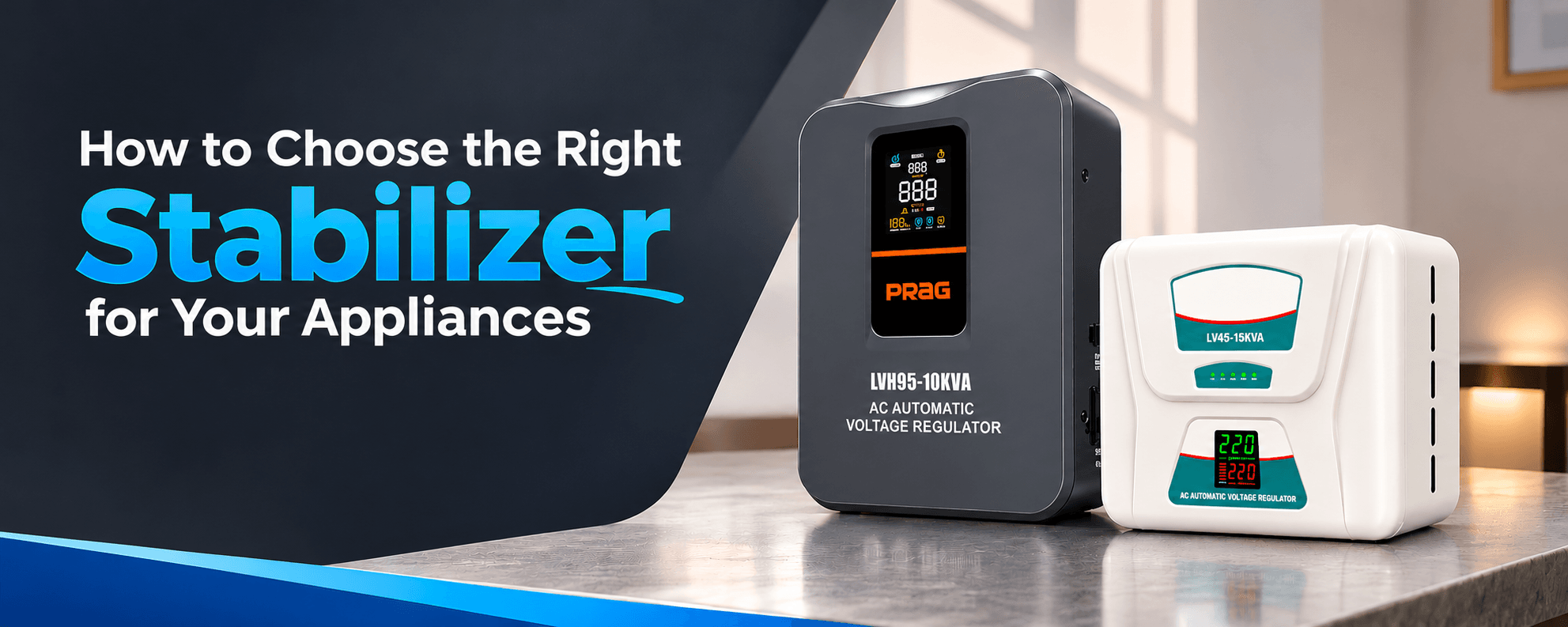
PRAG Central Stabilizers offers a solution for managing voltage fluctuations and protecting compatible connected equipment.
Find the Right PRAG Central Stabilizer
Choosing the right stabilizer is important for protecting your appliances from voltage fluctuations. The right choice depends on the equipment you want to protect and the voltage conditions in your area.
PRAG offers Central Voltage Stabilizer in different capacities. Check the specifications to find a model suitable for your home or business.
Not sure which one to choose? You can always contact the PRAG team for guidance.